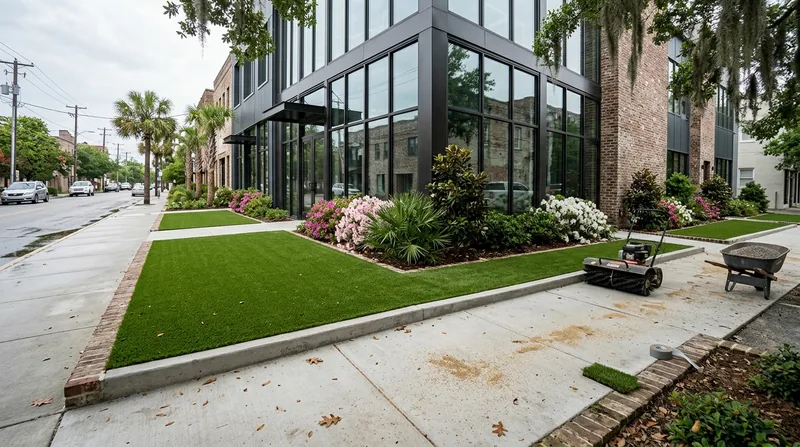




Commercial Artificial Grass Installation in Charleston transforms retail frontages, office parks, HOA common areas, dog parks, and hospitality venues into durable, low-maintenance landscapes that hold up to foot traffic, salt air, and the Lowcountry's intense humidity and afternoon thunderstorms. Charleston's commercial properties face real challenges: soggy, sandy soil over a high water table that drains poorly in the marshland terrain, live oak canopies that block sunlight and drop moss and limbs, salt spray near the harbor that corrodes natural grass, and the relentless heat and moisture that make real sod thin and spotty by mid-summer. Artificial turf solves these problems with a surface that stays green year-round, drains fast, and requires no mowing, fertilizer, or irrigation. We've installed turf in Mount Pleasant office parks, North Charleston retail centers, Summerville HOA common areas, and James Island commercial properties since 2013, working with property managers, landscape contractors, and business owners who need a surface that works in a climate where real grass struggles. This guide walks you through what commercial turf installation costs, how we approach each project, and how to hire a turf installation company that specs the product, names the infill, and stands behind the work.
Why Commercial Artificial Turf Matters in Charleston's Lowcountry Climate
Commercial properties in Charleston sit in one of the toughest climates for real grass on the US East Coast. The terrain is a low peninsula ringed by salt marsh and tidal creeks, with sandy, waterlogged soil that sits over a high water table. Summer heat runs into the mid-90s with near-daily afternoon thunderstorms and humidity that never breaks. Salt air from the harbor corrodes turf and metal. Live oaks draped in Spanish moss create deep shade where nothing grows. Real sod thins, goes bare in patches, and turns into mud after rain. Property managers face constant replanting, drainage problems, and the cost of maintaining a lawn that fails in the conditions. Artificial turf eliminates those headaches.
- We install turf that drains 60 inches per hour, moving water off the surface and through the base before it pools in soggy Charleston soil.
- Antimicrobial infill and reinforced drainage prevent odor and mold in high-humidity summers and tropical storm flooding.
- UV-stable fibers hold color under intense sun and salt spray without fading or brittling.
- The surface is dog-friendly, foot-traffic-proof, and safe for public use in retail, hospitality, and recreation settings.
- No fertilizer, pesticide, or irrigation means lower water bills and zero chemical liability on a commercial property.
These factors combine to make artificial turf the practical choice for property managers who want a surface that stays functional year-round in Charleston's climate.
Key info: A North Charleston retail center replaced a muddy, salt-damaged lawn with 2,400 square feet of commercial-grade turf last year. The property manager eliminated mowing, stopped replacing dead sod every spring, and recovered the cost in reduced maintenance within 18 months. That's typical for high-traffic commercial sites in the Charleston area.
For more information on how artificial turf performs in demanding conditions, see our guide to turf cleaning and pet odor treatment, which covers the maintenance side of commercial installations.
How We Install Commercial Artificial Grass in Charleston: Our Process
Every commercial project starts with a site walk and a written spec. We measure the square footage, test drainage, check soil compaction, and talk to you about foot traffic patterns, pet use, salt exposure, and shade. We then spec the turf by face weight, pile height, and infill type, name the base depth and compaction, and give you a written estimate with product details. This approach ensures the turf is right for the job and you know exactly what you're getting before we break ground.
- We call for a South Carolina 811 utility locate to mark public lines, then mark private irrigation, low-voltage wiring, and pet-fence lines by hand.
- We remove existing turf, concrete, or pavers if the scope calls for it, haul debris off-site, and grade the base to proper slope for drainage.
- We lay a weed barrier and a compacted base of stone or recycled asphalt, typically 2 to 4 inches depending on soil and use.
- We roll out the turf, seam it by hand with adhesive and backstitching, secure the perimeter with nails or adhesive, and brush the infill into the pile.
- We rake, inspect for seams and edge lift, and walk the entire surface to confirm drainage and finish quality before we leave.
The entire process takes 2 to 5 days depending on size, existing conditions, and base prep complexity. We work around your schedule and coordinate with other trades on the property.
Real example: A 3,200-square-foot dog park in Summerville required removal of old sod, grading to correct a low spot where water pooled, and installation of commercial-grade turf with antimicrobial zeolite infill. We started Monday, finished Thursday, and the park opened to dogs that Friday. The property manager reported zero odor complaints and zero algae growth through the following summer.
For details on how we handle repair work on existing turf, including seam reinforcement and edge lift, visit our turf repair and seam repair page.
Commercial Turf Installation Methods and What Works Best
| Approach | Description | Best for |
|---|---|---|
| Full removal and base prep | Remove existing turf or hardscape, regrade for drainage, compact stone or asphalt base, install weed barrier, then roll turf and seam. | Waterlogged Charleston soil, poor drainage, muddy or bare patches, or replacement of failed real grass. |
| Over-existing concrete or pavers | Lay underlayment with drainage channel, secure turf with adhesive or nails, seam edges to adjacent hardscape. | Patios, pool surrounds, retail frontages, or areas where removing concrete is not practical. |
| Turf over compacted soil (minimal prep) | Level existing soil, compact, lay weed barrier and thin base, roll turf and seam. Faster and lower cost if soil drains well. | Commercial sites with well-draining sandy soil or properties where digging and hauling must be minimized. |
| Seam and edge reinforcement | Repair or reinforce existing seams, re-adhere lifted edges, add backing strips, and backstitching to lock seams against foot traffic. | Existing turf with wear, separation at seams, or edge lift from foot traffic or equipment movement. |
The method we choose depends on the existing surface, soil drainage, and how long the turf needs to last. We recommend the approach that solves the drainage problem first, because turf installed on waterlogged soil fails fast in Charleston's climate.
Commercial Artificial Grass Installation Cost in Charleston: What to Expect
Commercial turf projects in the Charleston area range from small retail frontages to large office parks and recreation areas. Cost depends on square footage, existing conditions, drainage challenges, turf grade, and infill type. We provide a free commercial estimate on site, measure the space, assess soil and drainage, and give you a written spec with pricing before any work begins. The estimate includes travel in Charleston and surrounding areas, with no separate mileage or call-out fee.
Factors that move the price up or down include: the amount of existing turf or hardscape to remove and haul; whether the soil needs grading, compaction, or base stone; the depth and type of infill (standard recycled rubber, antimicrobial zeolite, or premium blends); the turf face weight and pile height; and the complexity of seams and edges. A simple 1,000-square-foot retail strip on well-draining soil costs less per square foot than a 3,000-square-foot dog park with poor drainage and extensive base prep. Getting 2 to 3 written estimates from turf installation companies lets you compare specs and pricing side by side. The cheapest estimate often means thinner turf, shallow base, or poor infill choice, which fails fast in Charleston's climate.
Visit our full pricing page for detailed cost ranges and worked examples for typical commercial square footages.
What to Look for When Hiring a Turf Installation Company Near Charleston
Hiring the right turf installer protects your investment and ensures the surface works in Charleston's climate. The key is to verify that the company has insurance, provides a written spec, checks references, and understands local drainage challenges. Many installers lay turf on bare dirt without base prep, use cheap infill, and leave within hours. That work fails in a year or less in the Lowcountry. A good turf installer asks about drainage, soil conditions, and use patterns before quoting, specs the turf by face weight and pile height, names the infill and base depth in writing, and stands behind the work with a workmanship warranty.
- Ask for a certificate of insurance naming general liability and workers' compensation coverage on the project.
- Request a written spec that names the turf product, face weight, pile height, infill type and pounds per square foot, and base depth and compaction method.
- Call at least two or three references from similar projects completed in the past two years, and ask about drainage, durability, and how the turf has held up.
- Confirm that the company understands Charleston's soil, drainage, and climate, and ask how they handle waterlogged or poorly draining sites.
- Check that the estimate is free and no-obligation, and that the company responds within 24 hours at a local phone number.
- Verify that the installer will coordinate with utility locates and handle private line marking by hand before digging.
These steps help you hire a turf installation company that delivers a surface built to last in Charleston's demanding Lowcountry conditions. For a free commercial estimate and a written spec, call us at (843) 994-2258 or contact us online. We're fully insured, we spec every job in writing, and we've been installing artificial grass and synthetic turf in Charleston since 2013.
Commercial Artificial Grass Installation in Charleston: Pricing Guide
| Service | Price | Details |
|---|---|---|
| Free commercial estimate | Free | On-site measurement, drainage assessment, soil and base evaluation, and written product spec with pricing |
| Small commercial site (500-1,500 sq ft) | Starting at $3.50 per sq ft | Retail frontage, small office patio, or HOA common area with basic drainage and minimal existing hardscape removal |
| Medium commercial installation (1,500-3,500 sq ft) | Starting at $2.75 per sq ft | Dog park, office courtyard, or hospitality venue requiring base prep, grading for drainage, and commercial-grade turf with antimicrobial infill |
| Large commercial or complex project (3,500+ sq ft) | On estimate | Extensive base prep, poor drainage correction, multiple seaming areas, or mixed hardscape and turf requiring site assessment |
| Travel and site visit | Included | No separate mileage fee or call-out charge in Charleston and surrounding service areas |
| Estimate response | Within 24 hours | Free written estimate with no obligation to book, delivered by phone or email at (843) 994-2258 |
Indicative pricing, the exact cost depends on square footage, finish, and site access. Free personalized estimate within 24h at (843) 994-2258.


