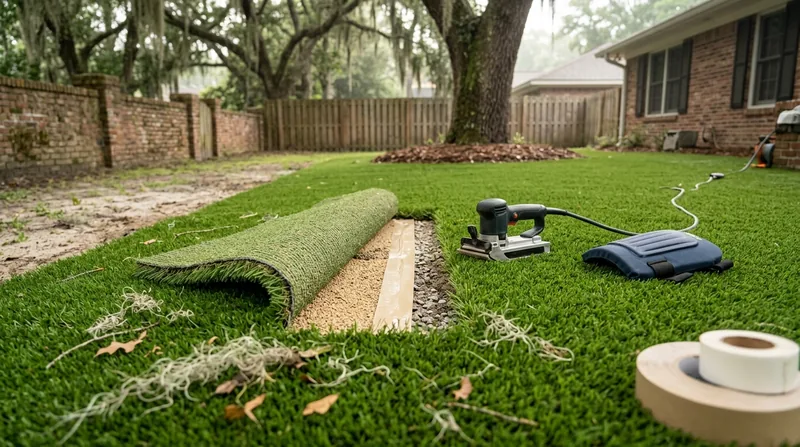




Turf Repair & Seam Repair in Charleston keeps artificial grass installations looking seamless and functional for years. In the Lowcountry, where salt air, humidity, and intense afternoon thunderstorms are routine, synthetic turf can develop seam separation, edge lifting, and surface wear that demand prompt attention. Whether your turf sits in a walled garden South of Broad, a new subdivision in Mount Pleasant, or a raised home on James Island, damaged seams and worn patches compromise both appearance and drainage. We locate and repair failed seams, re-secure lifted edges, patch sun-damaged spots, and restore infill where it has migrated or compacted. Our approach keeps the turf installation company relationship local and transparent: we specify the repair method, the materials used, and the warranty on workmanship before we start.
Why Seam and Edge Failure Happens in Charleston's Climate
Artificial turf seams are glued, not stitched, and in Charleston's environment they face real stress. The salt air near the harbor accelerates adhesive breakdown, while the intense humidity and near-daily summer thunderstorms drive water into joints and underneath the turf. Heavy foot traffic, pet claws, and the weight of furniture or equipment can peel back edges. Expansion and contraction from the heat also create small gaps that grow wider if left unrepaired. Once a seam begins to separate or an edge lifts, water pools underneath, infill washes away, and the base prep deteriorates.
- Salt spray and humidity degrade the polyurethane adhesive that bonds seams over time.
- Lifted edges allow water to flow under the turf and erode the base or cause mold growth beneath.
- Foot traffic and pet activity accelerate seam separation if the original installation did not account for heavy wear zones.
- Flattened or matted pile in high-traffic lanes makes the turf look worn and can hide underlying damage.
- Melt spots from window reflections or nearby heat sources create permanent damage to the fiber that cannot be filled.
Catching seam and edge problems early prevents water damage to the base and keeps your turf installation looking new.
Key info: In Charleston's salt-air environment, seam adhesive can begin to weaken within 3 to 5 years if the installation was not done with marine-grade polyurethane. We test adhesive integrity during inspection and recommend seam re-gluing as preventive maintenance before separation becomes visible.
How We Repair Seams and Edges: Our Process in Charleston
Our turf repair work begins with a site inspection to identify all failed seams, lifted edges, and damaged pile. We clean the seam area thoroughly, remove old adhesive, dry the joint completely, and apply a new marine-grade polyurethane bead. For lifted edges, we re-secure the perimeter with stainless steel landscape spikes and re-glue if needed. Patched areas are cut and seamed to match the surrounding turf, with new infill added to match the original depth and density. On patios, balconies, and pool surrounds where hard surfaces meet turf, we ensure water drainage and edge security so the installation does not shift.
- We inspect the entire installation to map all seams, edges, and damaged zones.
- We clean and dry each failed seam, removing loose adhesive and debris.
- We apply new marine-grade polyurethane adhesive to re-bond the seam and allow full cure time.
- We re-secure lifted edges with stainless fasteners and re-glue the perimeter where needed.
- We patch sun-damaged or worn areas by cutting and seaming new turf to blend seamlessly.
- We top-dress with fresh infill to restore proper drainage and pile height.
- We document the work in writing and provide a one-year warranty on all seam and edge repairs.
Every repair is completed in one visit whenever possible, and we schedule work to avoid weekend disruption in residential neighborhoods.
Example: A homeowner in Wagener Terrace noticed a seam separating along the side yard where the turf met a brick wall. We cleaned the joint, applied marine-grade adhesive, and re-secured the edge with stainless spikes. The repair took 2 hours, and the seam has held for 18 months with no re-opening.
Turf Repair Methods and When to Use Each
| Repair Method | Description | Best For |
|---|---|---|
| Seam Re-gluing | Remove old adhesive, clean and dry the joint, apply new marine-grade polyurethane, and allow full cure. | Separated or opening seams that have not yet caused water damage or infill loss. |
| Edge Re-securing | Re-glue perimeter seams and install stainless steel landscape spikes every 12 inches to lock edges. | Lifted edges along patios, decks, and property lines where foot traffic or pet activity pulls the turf. |
| Patch and Seam | Cut out damaged turf, fit new turf piece, glue seams, and blend infill to match surrounding pile. | Sun-damaged spots, melt marks, or localized wear zones smaller than 50 square feet. |
| Infill Top-Dress | Add fresh infill to seams and wear areas to restore drainage, pile height, and cushioning. | Compacted or migrated infill that has reduced drainage or made the turf look thin and flat. |
| Base Repair | Excavate, re-compact the base, improve drainage with additional gravel, and re-lay turf. | Failed seams caused by water pooling or soft, eroded base material underneath the turf. |
The method we recommend depends on the cause of the failure and the extent of damage. We always inspect the base before proposing a repair to ensure the foundation is sound.
Turf Repair and Seam Repair Cost in Charleston: What to Expect
Turf repair pricing depends on the scope of work, the number of seams that need re-gluing, and whether the base requires attention. A single seam repair typically starts at $350 to $500, while edge re-securing and infill top-dress run $400 to $800. Larger jobs involving multiple seams, patch work, or base repair can reach $1,200 to $2,500 depending on the square footage affected and access to the area. Travel within Charleston and the surrounding Lowcountry is included in our estimate. We recommend getting the turf inspected before booking so we can give you an accurate price based on what we find. For detailed pricing on artificial turf installation and artificial grass installation across all services, visit our pricing page.
Factors that affect repair cost include the number and length of failed seams, the condition of the base underneath, whether patches are needed, and the accessibility of the area. A homeowner who catches a seam separation early pays less than one who waits until water damage has eroded the base. We provide a free estimate within 24 hours of your call, and the price does not change once we have inspected the turf.
Turf Repair and Seam Repair Near Me: What Charleston Homeowners Should Know When Hiring
When you are looking for a turf installation company to repair or maintain your artificial grass, verify that the installer is fully insured and carries both general liability and workers' compensation coverage. Ask for a written estimate that specifies the repair method, the adhesive grade, the infill type and weight, and the warranty period. Check references and ask to see photos of completed repairs so you can see how seams look when done right. Do not hire based on price alone, especially if the estimate is significantly lower than others you have received. In Charleston, HOA rules may govern the appearance of front-yard turf, so check your deed restrictions before any visible repair work. For a free inspection and repair estimate, call us at (843) 994-2258.
- Verify the installer is fully insured and ask to see a certificate of insurance naming general liability and workers' compensation.
- Request a written specification that names the adhesive grade, infill type, and warranty on workmanship before work begins.
- Ask for references from homeowners whose turf was repaired in the last 12 months and follow up with at least two.
- Check your HOA deed restrictions or architectural guidelines to confirm that seam repairs do not violate any color or appearance rules.
- Confirm that the installer will provide a site inspection free of charge and document all findings before quoting a price.
Choosing a local, independent turf repair company means you work with someone who knows Charleston's climate, salt air, and drainage challenges, and who will stand behind the work with a written warranty.
Turf Repair & Seam Repair in Charleston: Pricing Guide
| Service | Price | Details |
|---|---|---|
| Single seam re-glue | Starting at $350 | Re-glue one seam with marine-grade polyurethane, clean and dry, cure time included, warranty one year |
| Edge re-securing with spikes | Starting at $400 | Re-glue and spike one edge (up to 50 feet), stainless fasteners, labor and materials, one-year warranty |
| Patch and seam small area | Starting at $600 | Cut, fit, and glue new turf patch up to 25 square feet, blend infill, full seam warranty, one year |
| Multiple seams and infill top-dress | Starting at $900 | Re-glue three or more seams, add fresh infill to compacted areas, restore drainage, one-year seam warranty |
| Base repair with re-lay | On estimate | Excavate, re-compact base, improve drainage, re-lay turf section, requires on-site inspection to quote |
| Free estimate | No charge | Site inspection, written estimate, response within 24 hours, no obligation to book, call (843) 994-2258 |
Indicative pricing, the exact cost depends on square footage, finish, and site access. Free personalized estimate within 24h at (843) 994-2258.


