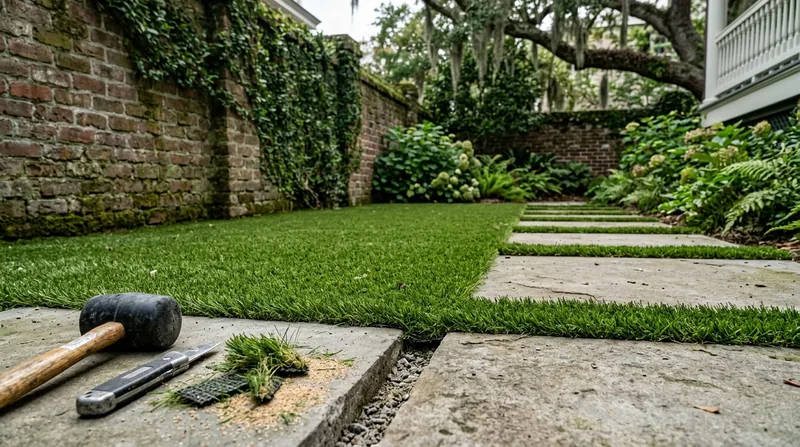




Charleston's outdoor living spaces tell a story of the city's architectural heritage and subtropical climate. From the brick-walled courtyards of historic single houses south of Broad to the deep porches of Lowcountry-style homes on Daniel Island, homeowners and property managers in Charleston, Mount Pleasant, James Island and across the Lowcountry are extending their living areas with patio, balcony and turf-paver strips that withstand salt air, high humidity, and the intense afternoon sun without the maintenance burden of natural grass. Whether you're installing synthetic turf on a concrete patio, creating a green balcony buffer on a raised home, or laying turf strips between pavers to soften hardscaping, artificial turf installation on hard surfaces requires a different approach than residential yard work. We handle the drainage, base prep, and product selection that make these installations last in Charleston's challenging environment. Our work covers patios, balconies, rooftops, and turf-paver combinations across the city and surrounding areas since 2013.
Why Patio, Balcony & Turf-Paver Strips Matter in Charleston's Climate
Charleston's summers are long, hot, and humid, with near-daily afternoon thunderstorms that can saturate any outdoor surface. Concrete and pavers absorb and radiate that heat, making them uncomfortable underfoot and visually harsh against the city's historic architecture. Synthetic turf on patios and balconies solves three problems at once: it cools the surface, adds visual softness, and creates a functional outdoor room that doesn't require the weekly mowing and fungal management that real grass demands in our high-humidity, salt-air environment. For raised homes on James Island, Folly Beach, or the Isle of Palms, balcony turf also buffers noise and provides a safe surface for children and pets on elevated decks. Turf-paver strips between hardscape materials break up the monotony of concrete or brick while maintaining walkability and drainage.
- Synthetic turf on hard surfaces eliminates the standing water and algae growth that plague concrete patios in Charleston's wet climate.
- Balcony turf absorbs sound and reduces surface temperature by 20 to 30 degrees compared to bare concrete in full sun.
- Turf-paver strips soften hardscape transitions, reduce heat island effect, and provide functional green space without the drainage headaches of a full lawn.
- Installation on existing concrete or pavers requires no grading work and can be completed in a single day on most residential properties.
These installations are popular across Charleston neighborhoods because they require low maintenance, survive salt spray near the harbor, and integrate seamlessly with the city's mix of historic and contemporary architecture.
Key info: Homes on pilings in James Island and Folly Beach benefit most from balcony turf because it reduces reflected heat, provides cushioning on elevated decks, and eliminates the mold and algae that grow on exposed wood or metal railings in our salt-laden, humid air. A turf-backed balcony also extends the usable season into the summer months when bare concrete is too hot to walk on barefoot.
For more context on how artificial turf installation works in residential settings, see our residential artificial grass installation page.
How We Install Patio, Balcony & Turf-Paver Strips in Charleston
Installation on hard surfaces follows a completely different sequence than yard work. We do not lay turf directly on concrete or pavers because moisture trapped underneath causes mold, odor, and premature failure. Instead, we prepare the surface with proper drainage, secure the turf to the substrate, and seal seams so water moves through the infill and away from the structure. The process takes one to three days depending on surface area, access, and whether we're working around existing structures, railings, or utilities. Every job starts with a site walk to check for drainage issues, confirm measurements, and identify any obstacles that affect installation cost or timeline.
- We assess the existing concrete or paver surface for slope, cracks, and drainage direction to ensure water flows away from the home or building.
- We lay a high-quality permeable underlay that allows water to drain while providing cushioning and protection against UV damage to the turf backing.
- We secure the turf to the underlay using a combination of adhesive and fasteners, depending on surface type and expected foot traffic.
- We cut and fit the turf around railings, planters, and other obstacles, then seal all seams with UV-stable adhesive to prevent lifting and water infiltration.
- We brush the infill into the pile, compact it, and inspect the entire installation for proper drainage and uniform appearance before we leave the site.
This step-by-step approach prevents the common failures we see on patios and balconies: lifted seams, trapped water, odor problems, and premature backing deterioration.
Local example: A raised Craftsman bungalow in Wagener Terrace had a brick patio that was cracked, slick when wet, and too hot for barefoot use in summer. We removed the damaged turf-paver combination that a previous crew had installed without proper underlay, installed a permeable drainage mat, secured new turf with full-perimeter fastening, and added a paver border. The job took two days and cost less than repointing the brick and sealing the concrete. The homeowner now uses the patio from April through October.
For repair work on existing installations, visit our turf repair and seam repair page.
Installation Methods and Materials for Patios, Balconies & Turf-Paver Strips
| Approach | Description | Best for |
|---|---|---|
| Patio turf on concrete | Full-coverage synthetic turf over a permeable drainage underlay, secured with adhesive and fasteners, seams sealed with UV-stable caulk. | Existing concrete patios that need cooling, softness, and low maintenance without removal or replacement. |
| Balcony turf installation | Lightweight turf product with reinforced backing and drainage, installed over a thin perforated underlay, fastened every 12 inches around perimeter and load-bearing edges. | Raised decks and balconies where weight and drainage are critical, and water must move quickly away from the structure below. |
| Turf-paver strips | Narrow synthetic turf borders installed between pavers or in gaps within hardscape, with underlay, adhesive, and edge banding to prevent uplift and weed growth. | Softening transitions between concrete, brick, or natural stone, reducing visual harshness and heat while maintaining walkable hardscape. |
| Rooftop turf installation | Heavy-duty turf with root barrier underlayment, installed on flat or low-slope roofs with proper drainage and wind-resistant edge fastening. | Converting unused roof space into functional green area for commercial properties, multi-family buildings, and high-end residential installations. |
Each method is chosen based on the surface type, expected use, and drainage requirements specific to your property and location in Charleston.
Patio, Balcony & Turf-Paver Strips Cost in Charleston: What to Expect
Pricing for patio, balcony and turf-paver strips starts at $9 per square foot for a straightforward installation on existing concrete with standard drainage and a mid-range turf product. Most residential patios in Charleston range from 300 to 800 square feet, putting typical jobs between $2,700 and $7,200 before any site-specific factors. Balcony installations tend to be smaller, typically 100 to 300 square feet, and may cost more per square foot because of the additional fastening, reinforced underlay, and precision required on elevated surfaces. Turf-paver strips are priced by the linear foot rather than area, usually $35 to $60 per linear foot depending on strip width and paver complexity.
Factors that move the cost up include cracked or uneven concrete that requires repair before installation, proximity to structures that require extra sealing or flashing, non-standard turf products (heavier face weight, specialized infill for pet or sports use), and complex edge detailing around railings or planters. Access also matters: a ground-level patio in Mount Pleasant is faster and less expensive than a third-story balcony in downtown Charleston that requires lifts or scaffolding. We always provide a written estimate after a site visit, and we recommend getting two or three estimates from different installers so you can compare materials, base depth, infill type, and workmanship warranty.
See our full pricing page for detailed cost ranges and examples for different property types and service areas.
Patio, Balcony & Turf-Paver Strips Near Me: What to Look for When Hiring a Turf Installation Company
Not every turf installer is equipped to handle hard-surface work, and the difference between a professional installation and a failed one often comes down to drainage, underlay quality, and seam technique. When you're comparing installers in Charleston, Mount Pleasant, Summerville, or any area in the Lowcountry, look for a company that can show you written specifications for the turf product (face weight, pile height, infill type and pounds per square foot), the underlay depth and permeability rating, and the base preparation method. Ask for references from recent patio or balcony jobs, and request photos of finished work so you can see how seams are sealed and how the turf sits at edges and transitions. A professional turf installation company will provide a certificate of insurance naming general liability and workers' compensation, and will stand behind the installation with a written workmanship warranty covering seams, fasteners, and drainage for at least one to three years.
- Request a written estimate that names the turf product, face weight, pile height, infill type and pounds per square foot, underlay type and thickness, and the complete installation method.
- Ask whether the installer has experience with balcony installations on raised homes, rooftops, or other non-standard surfaces relevant to your property type.
- Verify that the installer carries a certificate of insurance and can provide references from at least three similar projects completed in the past 12 months.
- Confirm that the estimate includes drainage, seam sealing, edge detailing, and any site prep needed to ensure the turf does not trap water or fail prematurely.
- Ask about the workmanship warranty, what it covers, and how long it lasts, and get the answer in writing before you sign any agreement.
If you have questions about permits, HOA approval, or drainage issues specific to your property, call us at (843) 994-2258 or visit our contact page to request a free estimate.
Patio, Balcony & Turf-Paver Strips in Charleston: Pricing Guide
| Service | Price | Details |
|---|---|---|
| Standard patio turf on concrete | Starting at $9/sq ft | Includes permeable underlay, turf, adhesive, fasteners, seam sealing, and infill compaction on existing concrete patio surfaces |
| Balcony turf installation | Starting at $12/sq ft | Lightweight turf product with reinforced backing, thin perforated underlay, and perimeter fastening every 12 inches for weight distribution and drainage on elevated decks |
| Turf-paver strips | Starting at $35/linear ft | Narrow synthetic turf borders between pavers or in hardscape gaps, including underlay, adhesive, edge banding, and compacted infill for weed prevention |
| Rooftop turf installation | On estimate | Requires on-site assessment of roof structure, weight limits, drainage, and wind exposure to provide accurate pricing for commercial and high-end residential roofs |
| Repair or seam work | Starting at $8/sq ft | Includes assessment, underlay replacement if needed, seam re-sealing with UV-stable adhesive, and infill restoration to extend life of existing installations |
| Free estimate | No obligation | Response within 24 hours, site visit included, written estimate with product specs and workmanship warranty details provided before any commitment |
Indicative pricing, the exact cost depends on square footage, finish, and site access. Free personalized estimate within 24h at (843) 994-2258.


