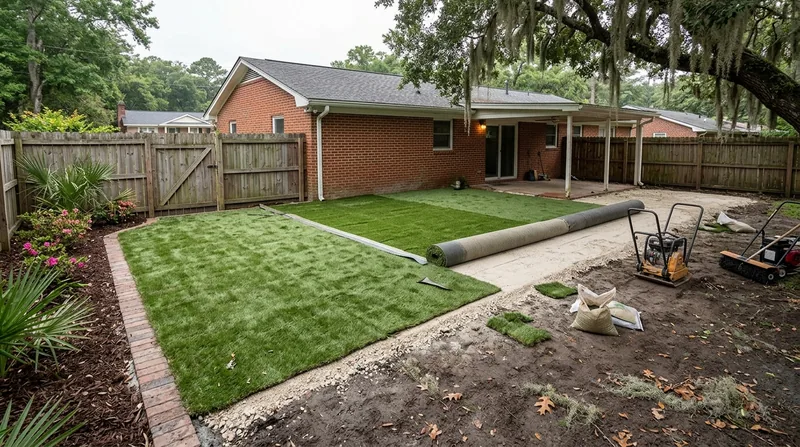




Residential artificial grass installation in Charleston transforms yards across the peninsula, from historic single houses with walled gardens South of Broad to Craftsman bungalows in Wagener Terrace to modern subdivisions in Mount Pleasant and Summerville. The Lowcountry climate and terrain pose real challenges: centipede and zoysia lawns thin under the live oaks draped in Spanish moss, soggy patches develop where sandy soil sits over a high water table, and salt air near the harbor stresses natural grass. Artificial turf solves these problems without the constant battle against humidity, shade, and drainage. We install turf that performs year-round, handles pets and foot traffic, and looks sharp in Charleston's mix of architectural styles and tight yards.
Why Residential Artificial Grass Installation Matters in Charleston's Unique Landscape
Charleston's yards sit in a tough spot. The combination of high humidity, afternoon thunderstorms from June through November, and a water table that rises with king tides creates conditions where real grass either drowns or dries out unevenly. Shade from massive live oaks, salt spray near the water, and compacted sandy soil make lawn maintenance a losing battle. Artificial turf eliminates the mowing, fertilizing, and replanting cycle while delivering consistent green that survives Charleston's climate.
- Eliminates weekly mowing and seasonal dormancy that leaves yards brown in winter or thin under oak canopies.
- Drains properly on sites where real grass turns to mud or develops algae in wet seasons.
- Resists salt air damage near James Island, Folly Beach, and the Isle of Palms where coastal homes see faster turf degradation.
- Handles heavy foot traffic and pet wear in yards where natural grass would thin to bare patches.
- Reduces water use and chemical inputs while maintaining curb appeal year-round in Charleston's hot, humid summers.
These benefits add up to a yard that works harder and requires far less intervention than struggling natural turf in the Lowcountry.
Key info: HOA architectural rules commonly govern front-yard turf in Charleston neighborhoods, particularly South of Broad, James Island, and Mount Pleasant. We help prepare HOA submittals and understand color, pile, and edging restrictions, but approval is the HOA's decision. Always check your deed restrictions before scheduling.
For detailed guidance on comparing artificial turf to natural sod and understanding the upkeep requirements, see our complete guide to artificial grass solutions.
How We Install Residential Artificial Grass in Charleston: A Step-by-Step Process
Our installation process starts with understanding your yard's drainage, shade patterns, and soil conditions. We request a utility locate from SC 811 before any excavation to mark municipal lines, and we work around private irrigation, low-voltage lighting, and pet-fence wires that the locate service does not mark. Base preparation is critical in Charleston's sandy, sometimes waterlogged soil. We remove existing turf, grade for proper drainage away from structures, compact the base to specification, and lay turf with seams positioned to shed water and foot traffic.
- We schedule a site visit to assess drainage, shade, soil type, and any existing features like patios or edging.
- We request SC 811 utility locates and identify private lines before excavation begins.
- We remove old turf, debris, and grade the yard to ensure water flows away from your home and toward natural drainage.
- We compact the base material and install a perforated underlay to manage water in areas prone to pooling.
- We lay and seam the turf, secure it with landscape staples, and finish edges with aluminum or steel edging.
- We brush and fluff the pile, infill the turf with sand or a specialized product, and perform a final walkthrough with you.
The entire process typically takes one to three days depending on yard size and site conditions. We clean up all debris and leave your yard ready to use immediately.
Example: A 1,200-square-foot yard in Summerville with patchy centipede lawn, two large oaks, and a drainage issue near the foundation required base regrading, perforated underlay, and a premium turf product rated for shade. The job took two days and resolved both the drainage and the thin-grass problem.
Learn more about our turf repair and seam maintenance services for long-term care after installation.
Installation Methods and Base Specifications
| Approach | Description | Best for |
|---|---|---|
| Standard Base Prep | Remove old turf, grade for drainage, compact 4 to 6 inches of base material, lay perforated underlay. | Most residential yards in Charleston with existing lawn and normal drainage. |
| Improved Drainage System | Grade with swales or slight slope, use perforated underlay and drain rock, compact base to 6 to 8 inches. | Yards with high water table, shade from oaks, or history of standing water and algae on natural grass. |
| Minimal-Disturbance Install | Compact existing turf, lay underlay and turf directly over prepared ground without full removal. | Yards where trees or structures limit excavation, or where minimal site disruption is essential. |
| Hardscape Integration | Install turf around existing patios, edging, or raised beds with proper transitions and sealing at edges. | Yards with defined garden spaces, patios, or existing brick and stone that must remain in place. |
Every installation includes written specifications: turf product name, face weight, pile height, infill type and pounds per square foot, and base depth and compaction. We name the materials so you know exactly what you are getting.
Residential Artificial Grass Installation Cost in Charleston: What to Expect
Cost for artificial turf installation in Charleston starts at $8 per square foot and varies based on site conditions, turf quality, and base preparation. A 400-square-foot yard typically runs $3,200 to $4,400 installed, while a 1,000-square-foot installation ranges from $8,000 to $12,000 or more. The final price depends on several concrete factors: whether the yard has good drainage or requires improved base work, the amount of shade from live oaks, existing hardscape that must be worked around, and the turf product you choose (face weight, pile height, and infill type all affect material cost).
Sites with wet soil, compacted ground, or significant grading needs cost more because base preparation takes longer and requires additional materials. Yards with heavy shade may benefit from premium turf products designed to perform under oaks, which increases the per-square-foot rate. Access, yard shape, and the number of seams also influence labor and material efficiency. Getting two or three estimates from local installers is smart; compare the turf specifications, base depth, and what warranty or guarantee each company offers on the installation.
Visit our detailed pricing page for worked examples and cost factors by yard size and condition.
Residential Artificial Grass Installation Near Me: What Charleston Homeowners Should Know When Hiring
Hiring the right turf installation company makes the difference between a yard that lasts ten years and one that fails in three. Look for a local, independent turf installer with a physical address in Charleston or Mount Pleasant, not a traveling crew or a dealer locked into one brand. Request a certificate of insurance naming general liability and workers' compensation coverage. Ask to see a written specification for the turf product, face weight, pile height, infill type and application rate, and base depth and compaction method. Check references and photos of finished work in your neighborhood or similar yards.
Understand that HOA approval, if required, is not guaranteed even with a professional installation. Many Charleston neighborhoods have architectural rules about front-yard turf color and pile height. We help prepare submittals, but the HOA board makes the final call. If your yard has a history of drainage problems or standing water, ask the installer whether base preparation will fix it or whether you should address the underlying issue first. A professional will tell you if turf is not the right answer for your specific site.
For a free, no-obligation estimate and to discuss your yard's specific conditions, contact us at (843) 994-2258. We respond within 24 hours and will walk you through options, costs, and timeline before you commit to anything.
Residential Artificial Grass Installation in Charleston: Pricing Guide
| Service | Price | Details |
|---|---|---|
| Small residential yard (400 sq ft) | Starting at $3,200 | Includes base prep, standard turf, underlay, and complete installation with edging and cleanup included |
| Medium residential yard (800 sq ft) | Starting at $6,400 | Base price assumes good drainage and minimal shade; increases if yard requires improved drainage system or premium turf |
| Large residential yard (1,200+ sq ft) | Starting at $9,600 | Per-square-foot cost may decrease slightly at scale; final price depends on site grading, shade from oaks, and turf product selected |
| Complex site with drainage or hardscape | On estimate | High water table, significant grading, existing patios, or multiple large trees require site visit to quote accurately |
| Travel and estimate | Free | No charge for site visit or written estimate; response within 24 hours to (843) 994-2258 across Charleston and surrounding areas |
Indicative pricing, the exact cost depends on square footage, finish, and site access. Free personalized estimate within 24h at (843) 994-2258.


