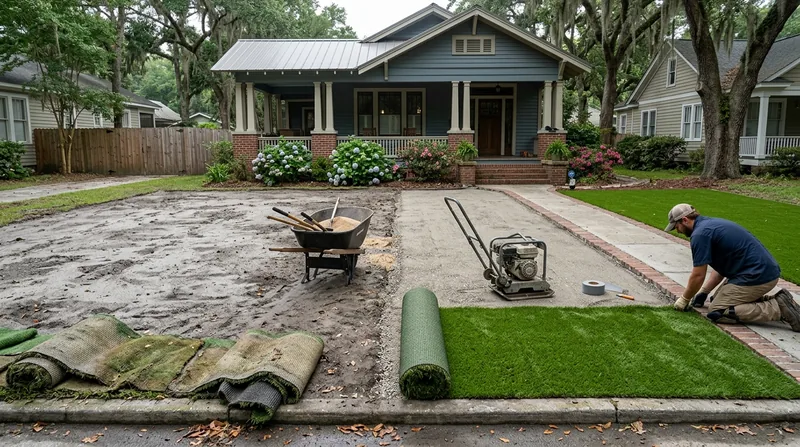




Charleston's low-lying terrain, high water table, and decades-old lawns that thin under live oak canopy create perfect conditions for turf failure. When centipede or zoysia grass dies back in shade, floods under king-tide conditions, or simply stops responding to heat and humidity, turf removal, replacement and lawn conversion becomes the practical path forward. Whether you're removing dead sod to install artificial grass, converting a wet corner to drainage-friendly turf, or clearing an old lawn to start fresh, we handle the full cycle from demo through base prep and new installation. We've served Charleston, Mount Pleasant, James Island, and the surrounding Lowcountry since 2013, working on everything from historic single houses south of Broad to new subdivisions in Summerville and Goose Creek.
Why Turf Removal and Lawn Conversion Matter in Charleston's Climate and Landscape
Charleston's combination of salt air, high humidity, and near-daily summer thunderstorms puts stress on natural turf that many homeowners underestimate. Centipede lawns thin dramatically under the dense shade of live oaks draped in Spanish moss, while zoysia struggles on the sandy, marshy soils that sit above our high water table. When drainage is poor, grass roots rot; when shade deepens, photosynthesis fails. Rather than fight the climate and terrain for years, many homeowners choose to remove the failing lawn and install artificial turf, which thrives in shade, handles flooding without rotting, and requires no fertilizer or pest control.
- We remove old sod, old artificial grass, or compacted dead lawn and haul away all debris in one trip.
- We grade and slope the site to direct water away from structures and toward natural drainage or storm drains.
- We install a proper base layer (crushed stone or recycled asphalt) compacted to code depth, not bare dirt.
- We lay new artificial turf installation or oversee conversion to native plantings if turf is not the right choice.
- We coordinate with South Carolina 811 utility locates before excavation to protect buried lines.
The result is a yard that works with Charleston's climate instead of against it.
Key info: Many Charleston yards on James Island, Folly Beach, and the Isle of Palms sit on pilings or raised foundations where standing water after storms is the norm. Removing a soggy lawn and installing artificial turf with a drainage-rated underlay solves the problem without costly grading or subsurface work.
How We Handle Turf Removal, Replacement and Lawn Conversion in Charleston
Our process starts with an on-site visit to assess soil condition, drainage, tree cover, and any utility lines or structures nearby. We then remove the old turf or pavement, prepare the base, and lay new artificial grass or recommend alternative landscaping. Every job is different, and we treat each yard as a custom project, not a template install.
- We inspect the site for irrigation lines, low-voltage lighting, pet fencing, and underground utilities before we break ground.
- We remove all old sod, dead grass, or existing artificial turf, including any compacted base material that drains poorly.
- We grade the yard to slope away from the house, deck, and pool, with proper fall toward storm drains or natural drainage paths.
- We install a compacted base layer (typically 2 to 4 inches of crushed stone or recycled asphalt) to support the new turf and allow water to percolate.
- We lay new artificial turf with a drainage-rated underlay, securing seams and edges per manufacturer spec.
- We infill the turf with the material you choose (silica sand, crumb rubber, zeolite, or Envirofill antimicrobial), then brush and settle it.
On a 1,000 square foot yard in Wagener Terrace, we removed a dying centipede lawn, regraded to fix standing water, installed a 2-inch recycled asphalt base, and laid a 50-ounce pet-friendly turf with Envirofill infill. The entire job took three days; the homeowner's dog now has a clean, dry play area year-round.
Key info: Drainage is not optional in Charleston. If your yard floods or stays soggy after rain, we fix the slope and base before laying turf. Skip this step, and you'll have a waterlogged yard and a failed installation within a season.
For more details on how we handle drainage and base prep for specific applications, see our residential artificial grass installation page.
Turf Removal and Lawn Conversion Methods: Choosing the Right Approach
The best removal method depends on the current state of the yard, the underlying soil, and what you plan to install next. We offer several proven approaches, each suited to different conditions and budgets.
| Approach | Description | Best For |
|---|---|---|
| Sod Stripping | We use a sod cutter to slice and roll away the top 1 to 2 inches of dead or failing turf, leaving the subsoil intact for regrading. | Small to medium yards with shallow-rooted turf, minimal compaction, or where you want to preserve existing soil structure. |
| Full Excavation | We remove all old turf, dead roots, and compacted soil down to 6 to 12 inches, then backfill with clean base material and regrade. | Yards with poor drainage, hardpan, standing water, or existing artificial turf that needs complete removal and fresh base prep. |
| Pavement or Deck Removal | We break out old concrete, brick, or patio pavers, haul away the debris, and prepare the subbase for turf or new hardscape. | Conversions from patio or driveway to artificial grass, or from hard surfaces to landscape plantings. |
| Selective Removal and Conversion | We remove turf from high-traffic or problem areas, leave stable sections in place, and blend new turf or plantings into the existing landscape. | Large yards where only portions need replacement, or where budget is phased and you want to tackle one zone at a time. |
Each method is priced individually based on site conditions, debris haul-off, and the complexity of regrading. We'll walk you through the options during a free on-site estimate.
Turf Removal, Replacement and Lawn Conversion Cost in Charleston: What to Expect
The cost of turf removal and lawn conversion in Charleston ranges from $2 per square foot for basic sod stripping on a well-drained yard, to $4 to $6 per square foot for full excavation, regrading, and new base prep on a property with drainage problems or compacted soil. A 1,000 square foot yard with moderate removal and base prep typically runs $2,500 to $4,500 before new turf installation. Several factors drive the final number.
- Debris haul-off and disposal fees vary by volume and local landfill rates; we include this in our estimate.
- Soil condition matters: sandy, well-draining soil costs less to prepare than clay, compacted, or waterlogged soil.
- Tree removal or heavy pruning to improve light and air flow may be recommended but is not included in turf removal pricing.
- Utility locate and mark (via South Carolina 811) is free, but if we hit an unmarked private line (irrigation, low-voltage, pet fence), repair costs are the property owner's responsibility.
- Slope and drainage work on a wet or flooded yard adds cost but prevents future failure and is worth the investment.
- New turf installation and infill are priced separately; see our full pricing page for base-to-finished-yard totals.
We recommend getting 2 to 3 estimates and asking each installer to specify what's included at their quoted price: removal depth, base material, compaction method, and haul-off. A single-line price without detail often means corners cut or surprises later.
Key info: On a James Island property where we removed 800 square feet of waterlogged turf, regraded to a 2-inch fall away from the house, and installed a 3-inch recycled asphalt base, the removal and prep alone was $3,200. Adding new 50-ounce artificial turf with zeolite infill brought the total to $6,800. The homeowner eliminated soggy lawn, flooding after storms, and the need for constant fertilizer and mowing.
Turf Removal, Replacement and Lawn Conversion Near Me: What Charleston Homeowners Should Know Before Hiring
Choosing the right turf installation company for removal and conversion work is as important as choosing the right turf product. A poor removal job leaves you with bad drainage, compacted soil, or incomplete debris haul-off that haunts you for years. Here's what to verify when you're comparing installers in Charleston and the surrounding areas.
- Ask for a certificate of insurance naming general liability and workers' compensation; a reputable turf installer carries both and provides proof on request.
- Request a written spec for the removal method, base material, compaction depth, and what's included in the haul-off and disposal price.
- Check references from recent projects in your neighborhood (Wagener Terrace, Avondale, James Island, Mount Pleasant) and ask to see finished photos of similar removals and conversions.
- Confirm that the installer requests a South Carolina 811 utility locate before breaking ground and asks you about private lines (irrigation, pet fence, low-voltage lighting) on the property.
- If your yard is in an HOA community, ask whether the installer has experience with HOA submittals and architectural approval; we help with these, but approval is never guaranteed.
- Get the estimate in writing with a start date, completion timeline, and a clear price per square foot or flat fee with no hidden charges for debris or travel.
We're fully insured and have been removing and converting yards in Charleston since 2013. Call us at (843) 994-2258 or request a free estimate to discuss your specific yard and get a detailed quote with no obligation.
Turf Removal, Replacement & Lawn Conversion in Charleston: Pricing Guide
| Service | Price | Details |
|---|---|---|
| Sod Stripping (Basic Removal) | Starting at $2/sq ft | Includes sod cutter removal, debris haul-off, and light grading for yards with good drainage and shallow roots |
| Full Excavation and Base Prep | Starting at $4/sq ft | Includes removal of old turf and compacted soil, regrading, 2 to 4 inch compacted base layer, and proper slope for drainage |
| Pavement or Deck Removal and Conversion | Starting at $3/sq ft | Includes concrete or paver breakout, debris haul, subbase prep, and readiness for new turf or landscape plantings |
| Drainage Problem Yards (Wet, Flooded, High Water Table) | On estimate | Requires site visit to assess slope, soil type, and subsurface water; regrading and specialized base work may increase cost significantly |
| Travel and Estimate | Free | No charge for on-site visit, measurement, and written estimate; included in Charleston and surrounding service areas within 15 miles |
Indicative pricing, the exact cost depends on square footage, finish, and site access. Free personalized estimate within 24h at (843) 994-2258.


